
The advantage comes not from strategy but from how fast you get back into action
How a top manager and an organization move through the emotional cycle faster than competitors. A chapter on the person, a chapter on the organization and ten worked cases — with the diagnosis and what was done next.
Sergey Parshakov · AIC’s proprietary model · 2026
The full text is open, with no registration. The form is only needed for the files.
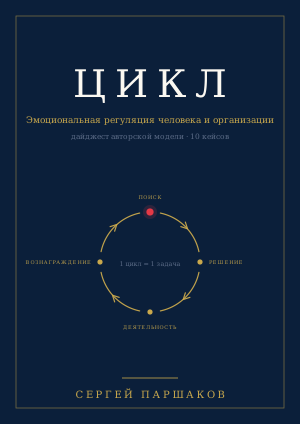
Four phases of one mechanism
Both a person and an organization go through the cycle — and get stuck in it in the same way. One cycle, one task: from the first assessment to locking in the result.
Sadness and contemplation are the starting point
The cycle begins not with a feeling but with an assessment: something doesn’t add up. This is the phase management most often skips — and later has to come back to.
Fear as a filter, not a verdict
Here anxiety works as a filter of significance: it screens out what isn’t worth taking on. The moment when uncertainty turns into a decision.
Work as productive tension
The peak phase: enthusiasm and tension together. Calm here is not a sign of health but a sign that the cycle never started.
The trap of quickly fading joy
Locking in the result — and the reason the cycle doesn’t close: joy fades before it can become a foothold for the next round.
Plus the idea of nested cycles — clockwork, not a single gear — and a cross-cultural caveat: the mechanism is the same, the volume differs.
Two chapters on the model and ten cases
Part I. The model
- The cycle of emotional regulation and self-regulation: the person
- The same cycle at the scale of an organization: the Emotions domain in the QAC management system
The second chapter covers five maturity levels of the Emotions domain and three practical tools for moving from chaos to a system.
Part II. Ten top-manager cases
- Thirty days of silence
- The director who forgot the word “enough”
- The middle managers’ revolt
- “The best people are leaving”
- Data that contradict each other
- “The board is in a panic”
- “Competitors cut prices by 40% with AI”
- “Growth with no one to deliver it”
- 72 hours after an incident
- “A year after hitting bottom”
Every case is built the same way: situation → diagnosis through the cycle → what was done → what changed. Twelve infographics.
Emotions are not a “soft topic” but a domain of the management system
“CYCLE” unfolds one domain of the larger model. In the book “The Living Digital Organization,” emotions sit in the 6×6×3 architecture on a par with technology; here we show how this domain works from the inside — in a person and in an organization.
You can read them in any order: “CYCLE” is shorter and closer to practice, while “The Living Digital Organization” gives you the whole framework.
The Emotions domain · the QAC model
RCIS certificate No. 1219-167-662 · NRIS No. 348-374-621 · December 20, 2025
DOI 10.5281/zenodo.20143048
Download the digest
You can read without any forms — the interactive version is open right here (in Russian), with chapter navigation and zoomable illustrations. The files are available via a short form.
You are free to read the digest and share it with colleagues. The rights to the text and the model belong to the author.
Done — the files are below
Thank you. The links are open:
If you recognized your situation in one of the cases
Let’s discuss it on your task: 30–40 minutes with a partner and an honest answer on where exactly the cycle gets stuck and whether there is a management lever here.