
A master loses deals in the same places every time
A beginner fails everywhere, and differently each time. An experienced seller’s large deals die predictably: the stretches covered hundreds of times are polished until they run on autopilot, while the junctions between them are left in the dark. Deals die at the junctions.
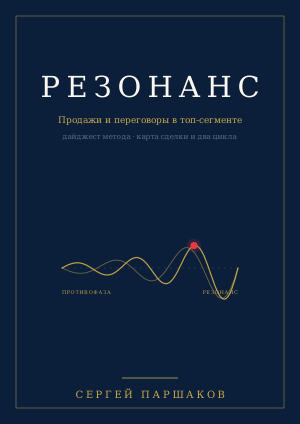
Sergey Parshakov · 22 chapters, 23 diagrams · 2026
The full text is open, with no registration. The form is only needed for the files.
Four tools instead of intuition
The method doesn’t replace experience; it lights up the junctions: the places where mastery breaks off and a deal slips away for no visible reason.
Fourteen nodes, with the dips built in
The client learns to buy from you — it is a route, not an event. The route has a peak, failure branches and dips that come not through the seller’s fault but from the way the road is built.
What happens to the client — and to you
The emotional cycle runs in both of you at the same time. Hence contagion and the tuning fork: whoever has the stronger cycle leads. A dashboard instead of intuition.
Arsenal and boundary on two axes
Where influence ends and manipulation begins is not a question of ethics in general but of the economics of a specific deal. The disclosure test answers it in a single move.
The operator: second attention
A negotiator’s maturity is measurable. Five stages with the transitions described and a portrait of a master in numbers — so you know where you are and what to master next.
Twenty-two chapters in five parts
Part I. The map
- Why masters lose deals that were “already in the bag”
- The deal curve: the client learns to buy from you
- Two cycles: what happens to the client and to you
- Arsenal and boundary: the influence matrix
- The operator: second attention and five stages of maturity
Part II. The road of a sale
- The setup: four questions before the first word
- The first minutes and the first regression: expert status
- SPIN: exploring the client’s request
- Risk: the second regression
- Demonstration: benefits versus features
- Commitment: check — summarize — propose
Part III. Negotiation
- A change of genre: where selling ends and bargaining begins
- The negotiation passport
- At the table: the emotional cycle of negotiation
- Bargaining: anchors, concessions, packages
Part IV. Difficult stretches
- Cold contact: the curve begins before you meet
- Objections: treat them or don’t create them
- Pressure and manipulation: the lower quadrants
- When a deal breaks down or stalls: coming back from “looking for alternatives”
Part V. The operator and practice
- Your own cycle: recovering after a defeat
- The debrief protocol: 15 minutes after the meeting
- 90 days: a self-training program
Plus the foreword “Why an experienced seller needs this book,” the conclusion “The first Monday” and appendices. Twenty-three diagrams.
The method doesn’t pretend to be a discovery from scratch
Chapter eight covers SPIN — the needs-exploration technique developed by Neil Rackham. “Resonance” doesn’t rewrite it under its own name; it shows on which stretch of the map it works and where it stops working.
The first chapter is built the same way: a map of the schools — who covers what, the three gaps between them and the formula that fills those gaps. The method’s claim is narrow and verifiable.
22 chapters · 23 diagrams
201 pages in the PDF
The full text is open online, in Russian
Download the digest
You can read without any forms — the full text is open right here (in Russian), with chapter navigation. The files are available via a short form.
You are free to read the digest and share it with colleagues. The rights to the text and the method belong to the author.
Done — the files are below
Thank you. The links are open; download in any format:
Read the digest on your own — master the method in a group
The text gives you the map. The skill is built in a two-day corporate training program: breakdowns of your own deals, practice on the nodes of the route and a debrief protocol the team takes away with it. Format and price — on request.